After I finished touring gallery #5, I was inside of gallery #1. Gallery #1 is the largest exhibit hall at the museum, and along with gallery 2 and 3, they display historical items that span the entire Chinese history in chronological order, starting at the prehistoric age of 1.15 million years all the way to the last Qing Dynasty in Chinese history.
At the entrance of the first gallery, it starts off with the earliest prehistoric age - about 1.15 million years ago up to the 21st century BC. Shaanxi province is one of the regions with the earliest human activities. About 1.15 million years ago, Lantian Man lived at the northern foot of Qinling montains in Shaanxi. About 8,000 years ago, chinese ancestors started to settle down and make a living by farming.
In this section, fossils, and various tools made of bones were on display. There was also a recreated model site showing what the Jiangzhai tribe village would have looked like. The Jiangzhai village is located 1km north of Lintong County (close to Xian), and is estimated to have existed about 6,000 years ago. The village covers 33,600 square meters.
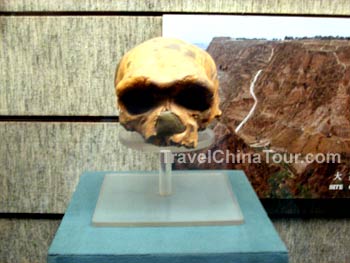
A fossil of the skull of Dali Man found from the Paleolithic age (about 200,000 years ago). This skull was excavated from Duanjiaxiang Dali County.
Zhou Dynasty 21st Century BC up to 770BC
Next section was the Zhou Dynasty. Around 16th century BC, a clan named Ji formed in western Guanzhong. They eventually took over the rule from the Shang Dynasty and established the Western Zhou Dynasty in 1066BC. They made Haojing (southwest of Xian) as their capital, setting the stage for Shaanxi to become the polical, economical, and cultural center of China for the next 2,000 odd years.
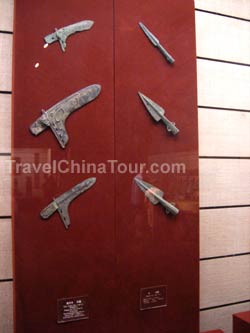
Weapons and spearheads found from the Zhou Dynasty
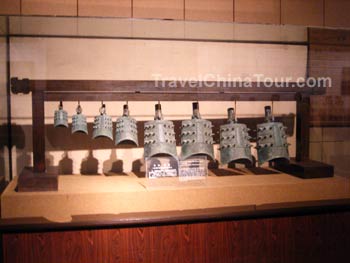
Bells from the Zhou Dynasty. In early period of Zhou Dynasty, a complete set of bells comprised of just 3 bells. Later on, the number increased to more than ten. The above photo is an exhibit of 8 bells, which is one of the larger sets that has been excavated.
Qin Dynasty 770BC - 206BC
The Qin people were one of the clans of Huaxia (the ancient name of China), and they had been active around Qianlong areas. After King Ping of the Zhou dynasty moved east in 770BC, they made Shaanxi province their base and expanded quickly. By 221BC, they (Qin Shihuang) conquered the six other states and established the first unified China. The main cultural relics on display here include the terracotta warriors, horses, and all types of weaponry to demonstrate the military advances of the Qin Dynasty.
I have plenty of photos of terracotta soldiers and warrios posted here if you want to see them. Instead here's some interesting photos of weapons and currency excavated from the Qin Dynasty.
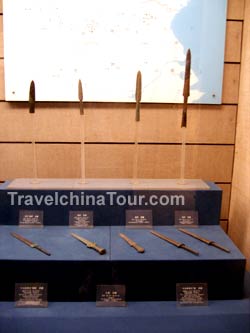
Daggers, swords, and spearheads from the Qin Dynasty.
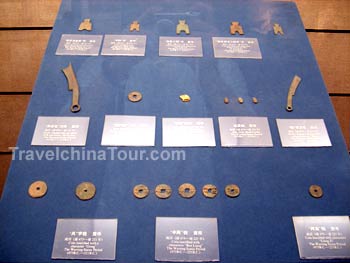
Various coins, and currency that was used during the Qin Dynasty - most of the coins and currency in the photo above are from the period of 475BC to 221BC). The 2 long, knife shaped coins are called "Knife coin" or "Dao Bi".
The Qin Dynasty exhibit area concludes my tour of Gallery #1, and up to the second floor I went to Gallery 2 and 3. Read next part... |