Beihai Park is located west of the Forbidden City, within walking distance. It consists primarily of the Beihai Lake and Qionghuadao Island. Then park covers an area of 68 hectares, with the lake covering most of the area. Beihai park was the former imperial palace of several ancient Chinese dynasties including the Liao, Jin, Yuan, Ming, and Qing, and it is the oldest and best preserved classical imperial garden in the world.
Since early 10th century, the Liao dynasty built a secondary imperial palace here called Yaoyu (Jade Island). When the Jin Dynasty took over, this place was renamed the capital Zhongdu, or central capital, and an imperial palace was built here. The lake was dredged and expanded as well, and the island was renamed to Qionghuadao. Two palaces were subsequently added named Yaoguangdian (Palace of Bright Jade), and Guanghandian (Palace in the Moon).
During the Yuan Dynasty, Kublai Khan planned his capital city, the Yuan Dadu (great capital) around Qionghuadao. The island and Beihai Lake were included in the imperial city and were given new names - Wanshoushan (Longevity Hill) and Taiyechi (Celestial Pool).
In 1420, under Emperor Yongle's reign, after construction of the Forbidden City, this area became the Western Imperial Garden for the Ming Dynasty emperors. Beihai lake was further extended south, and divided into three lakes, and more buildings were erected. More large scale renovation and construction took place during the Qing Dynasty. During Emperor Shunzhi's reign, the Tibetan style white Dagoba was built.
Beihai Park is an artistic masterpiece of China's classical gardens, and it is one of the best preserved imperial gardens in China. It has inherited the tradition and culture spanning many ancient Dynasties.
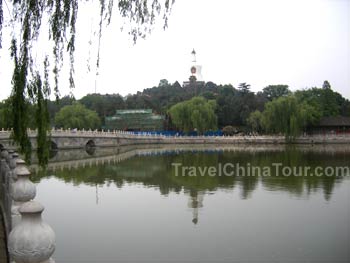
Beihai Park in Beijing.
The white Dagoba sits in the center of the island on top of the hill, and all the other structures are laid out around the white Dagoba. It was originally built in 1651. It stands 35.9 meters high, and built on a square stone base.
On the southern shore of Beihai Lake is the Tuancheng, or Circular City. it is 276 meters in circumference, and covers an area of 4,500 square meters. It is surrounded by a 4.6 meter high wall.
One of the main structures in Tuancheng (circular city), is the Chengguangdian (Hall of Receiving Light). It is a square shaped building facing south. Inside the building is a 1.5 meters tall statue of the Buddha Skyamuni, carved out of a whole piece of white jade.
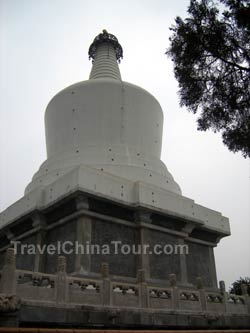
The white Dagoba.
On the northern shore of Beihai Lake is Jingqingzhai (Clear Mirror Study) - it is a classical imperial garden where Emperor Qianlong read, and was later used as the study for the crown princes.Cixi also came here every summer to escape from the summer heat. Also on the northern shore of Beihai Lake is the Famous Nine Dragon Screen. It is considered the most beautiful of the three Nine Dragon Screens in China today. The wall is 6.65 meters high, 27 meters long, and 1.2 meters thick. On both sides of the wall are carved 9 dragons painted in lively colors.
|