Shanghai is world famous for being a metropolis of three
key interests: businesses, shopping centers, touring and
sight seeing. But the city was not always like that.
6,000 years ago, Shanghai's location was the site of the
Songze Culture. The earliest ancestors of Shanghai people
are born here, and the site lies just west of the Shanghai
Hongqiao Airport.
During the period of the warring states (475 - 221 BC),
the state of Chu gave this piece of land to Prince Chun
Shen, and at that time, it was named "Shen". Several
hundred years later, this piece of land became a fishing
village during the East Jin Dynasty (317 - 420 AD). A local
official named Yu Tan built a fishing facility, and the
place was known as "Wu" at that time.
The name "Shanghai" first appeared in 960, and
in year 1290 of the Yuan Dynasty (1271 -1368), Shanghai
was formally built into a city. By the time of the Ming
Dynasty (1368 - 1644), Shanghai began to flourish with the
backing of its seaport - it became known as the "bustling
port and grand metropolis in the southeast". In 1554,
a 7 meter high city wall was built.
By the 17th century, there were signs of growing wealth
in Shanghai. After the first opium war (1840 - 1842), foreign
settlements from Britain, America, France, and Japan appeared
one after another. After the opium wars in 1843, Shanghai
was forced to become an open trade port. In 1927, the city
became a special municipality under the Kuomingtang regime.
In 1949 after founding of the People's Republic of China,
Shanghai became one of the municipalities directly under
the central Government.
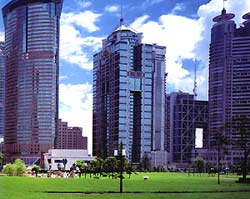
Shanghai Today
Today, Shanghai is a dynamic city going through dramatic
changes year after year. In 2002, Shanghai began construction
of a new deep-water container port. The new port allows
access of container ships that can carry between 5,000 to
6,000 20-foot containers. Shanghai is also the only city
in China with two international air ports, with the annual
capacity to handle 100 million passengers.
The Shanghai Maglev Train is the world's first magnetic
levitation train. The 30km trip between Longyang Road Station
and shanghai Pudong International Airport takes only 7 minutes.
The Maglev train has top speed of 430 km/hr.
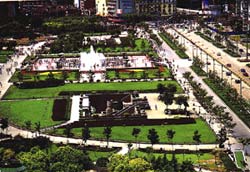
The Oriental Pearl
TV Tower is the highest in Asia, and 3rd highest in
the world. It's 468 meters high, and visitors can enjoy
a panoramic view of the city. There's so much more to Shanghai
than listed here such as the Jade
Buddha Temple, Yu Garden, Shanghai
Museum, Shanghai Concert Hall, Shanghai Ocean Aquarium,
the Bund, and much more. |