The Terra Cotta army and soldiers discovered near Xian
was the creation of emperor Qin Shi Huang, who was the first
emperor of a unified China in the 200's BC. Qin Shi Huang
lived from 259 to 210 BC, and reigned from 246 to 210 BC.
He became king at age thirteen, and campaigned for 10 years
from 230 to 221 BC to annex the other six independent states.
During his reign, Qin Shi Huang standardized the currency,
created a uniform law, standardized weights and measurements,
and also designated the written language. During that time,
he also connected all the walls built by the independent
states to create the Great
Wall of china.
The Mausoleum of Qin Shi Huang was built in the third century,
and covers over 56 square kilometers. It is fortified with
gates, watch towers, and turrets. According to historical
records, construction of the tomb took 36 years, and required
the labor of 700,000 people.
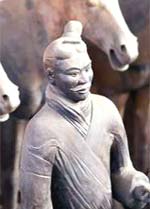
Unique Terra Cotta Soldiers
Of the 8,000 terra cotta soldiers, no two soldiers have
the same face and features. Each figure has different hair
style, expression, and facial features. See pictures of
the Terra Cotta warriors above and below:
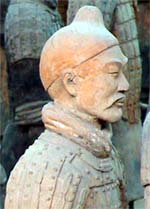
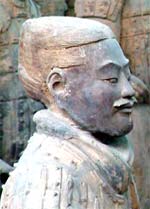
(Picture of TerraCotta Warriors: Notice the difference in
hair, eyes, eye brows, facial hair, and shape of the face
and jaw line.)
The life sized warriors were dressed for battle, and are
equipped with various weapons such as spears and swords.
Each soldier stood 1.8 meters tall, and wears an army uniform
distinguishing their rank. This Terra Cotta army is a slightly
idealized representation of the Qin army at that time. The
TerraCotta soldiers were originally painted with bright
colors, but after 2,000 years being buried underground,
most of the paint has peeled away. It is also believed that
the artisans created some of the terra cotta soldiers after
live model warriors. |