Beijing China City Guide
Beijing China History
Beijing Duck, Peking Duck
Forbidden City in Beijing

  › Forbidden Palace - Wumen Gate
  › Three Great Halls
  › Nine Dragon Wall
  › Inner Palace of Forbidden City

Great Wall of China
  › Badaling Great Wall & Mutianyu
  › Juyongguan Great Wall & Simatai

HONG KONG CITY GUIDE
Hong Kong City Guide
Hong Kong History
Hong Kong Attractions
Ocean Park Hong Kong
Victoria Peak
Wong Tai Sin Temple

SHANGHAI CITY GUIDE
Shanghai China city Guide
Shanghai History
Jade Buddha Temple
Oriental Pearl TV Tower
Shanghai Bund & Huangpu River
Shanghai Museum

XIAN CITY GUIDE & TOUR
About Xian City (Xian City Guide)
Banpo Village Museum
TerraCotta Army Discovery
TerraCotta Warriors - History
Mausoleum of Qin Shi Huang
Tour of Terra Cotta Museum
Xian City Wall

TRAVEL CHINA & CHINA TOUR
About China
China Tourism
Chinese Food & Cuisine - 1
Chinese Food & Cuisine - 2
My Impressions of China

TOUR CHINA BY PROVINCE
Guangdong Province
  › Guangzhou City Guide
     › Six Banyan Tree Temple
    > Sun Yat-sen Memorial Hall

  › Shenzhen City Guide

Guangxi Province
  › Guilin City Guide
  › Li Jiang River Tour
  › Nanning City Guide
  › Yangshuo City Guide

SiChuan Province
SiChuan Cuisine & Food
SiChuan Mah Jong
  › Chengdu China City Guide
     › Du Fu Thatched Village
  › Chengdu Shopping
  › ChongQing China City Guide
  › Emei Shan
  › JiuZhaiGou Tour
  › Leshan Giant Buddha
  › Neijiang China
  › Wolong Panda Reserve
  › WuLiangYe & Zigong Dinosaur


Chinese Terra Cotta Warrior

Mausoleum of Qin ShiHuang

Emperor Qin ShiHuang was well aware of his on mortality, and ordered construction of his tomb at a young age. He had sent thousands of his men overseas to discover the secrets of immortality, and visited holy mountains himself to have deep conversations with the gods. Many view Qin ShiHuang as a tyrant, and his arrogance is well documented.

Ancient Chinese believed that the soul lived on after death, so that the dead requires the same treatment as the living. Emperor Qin ShiHuang constructed a tomb with a Terra Cotta army of 8,000 soldiers to protect his spirit after death.


According to Sima Qian (historian of the Han Dynasty), the coffin of Emperor Qin Shi Huang was cast in bronze, and the underground palace was a replica of the imperial palace above ground. Within the tomb, traps with shooting arrows were installed to fend off grave robbers.
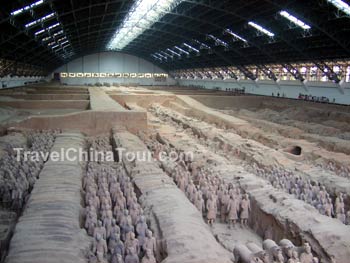
china terra cotta army
(Photo of Terra Cotta Warriors in Pit 1)

Making of the Terra Cotta Soldiers & Army

Each terra cotta soldier was individually fashioned, and crafted with care. The legs are solid, while the upper torso is hollow, formed with an inner core of coiled strips of clay. Finer clay was then molded on top of this core. The facial features and expressions are then individually added by the artisans.
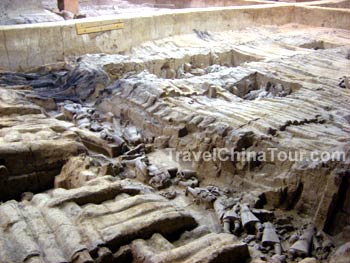
china terra cotta army
(Picture of broken Terra Cotta figures.)
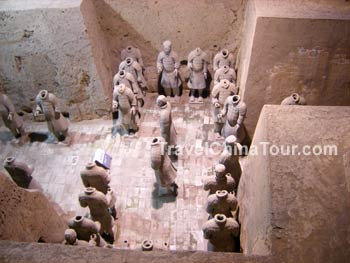
china terra cotta army
(Picture of some headless Terra Cotta figures.)


© 2006 - 2007 TravelChinaTour.com