The Yellow River Valley is recognized by history as the
birthplace of the Chinese civilization, and more than 400
sites have been discovered where the Yangshao culture once
thrived. The remains of Banpo Village happens to be the
largest and best preserved site.
The Yangshao culture from the neolithic age dates back
about 6,000 years, around (5,000 to 3,000 BC), and the earliest
beginnings of the Chinese civilization traced back to them.
The Yangshao culture is characterized by finely painted
pottery.
The Yangshao culture was matriarchal where women were buried
with more property than men. History also records that in
the Yangshao culture, people knew their mothers, but not
their fathers.
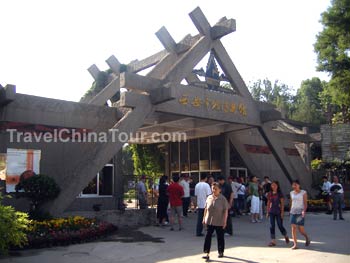
Banpo museum is located at the eastern outskirts of Xian.
The remains of Yangshao were first discovered in 1921. Artifacts
have been unearthed from the banpo site that are the only
remains of this prehistoric culture.
The Banpo Museum
Banpo Village occupies an area of about 50,000 square meters.
The village consists of a main residential section of about
30,000 square meters, a pottery area, and burial grounds
to the north. So far, about 10,000 square meters of the
Banpo Village have been exhumed.
Five excavations took place from 1953 to 1957, and uncovered
large amounts of prehistoric artifacts:
- 46 dwellings
- 200 storage pits
- 250 tombs
- 73 burial jars for children
- more than 10,000 stone tools and everyday articles
- 6 pottery kilns
The dwellings are round or pyramidal structures with straw
roofs supported by wooden beams, and the floors sunk 2 to
3 feet into the ground and contained a central fire pit.
It's estimated that the area of 50,000 square meters supported
a population of about 200 people. The tools they used were
made primarily of stone, and finer tools such as fish hooks
and needles were made of bone. These findings suggest that
the Yangshao people farmed, fished, and had domesticated
animals.
A large number of pottery crafts was unearthed at the Banpo
Village remains. The Yangshao people created many types
of pots for cooking, drinking, food storage, and for the
burial of ashes. All these artifacts provide solid evidence
for the existence of settled communities in prehistoric
China.
Tour Banpo Village Museum
While about 10,000 square meters have been exhumed, the
exhibition area of Banpo Museum is about 4,500 square meters
divided into two main exhibition halls. These halls exhibit
unearthed relics and artifacts from Banpo Village such as
production tools and domestic tools. These include tools
such as axes, sickles, and knives.
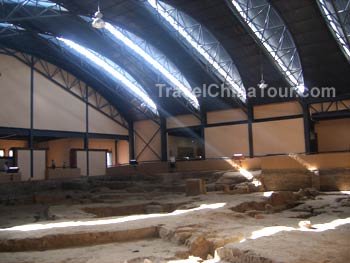
The site hall contains three sections of the Banpo Village:
residential, pottery making, and burial. Here you will see
things such as huts where the Yangshao people lived in;
the kilns where pottery was made; and tombs where Yangshao
people were buried. The Banpo Museum is very interesting,
and offers a unique insight into the prehistoric Chinese
civilization. |